

Feeding Line
+86 13784166699
+86 15064269689
System Overview
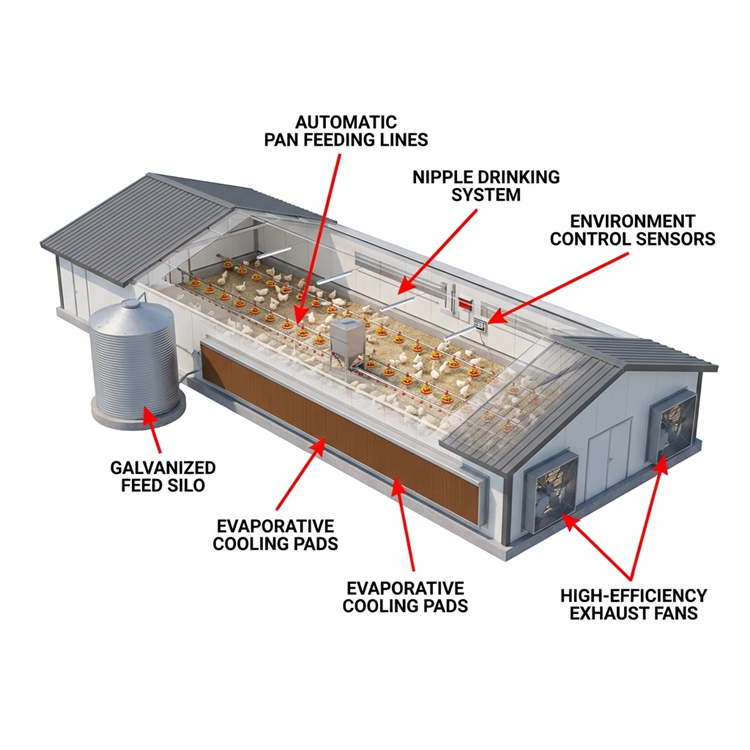
The diagram illustrates a state-of-the-art, fully integrated poultry farming solution designed for maximum efficiency, bird welfare, and operational control. This turnkey system represents a holistic approach to modern poultry production, moving far beyond simple equipment to create a synchronized environment where every element works in harmony. By automating critical processes such as feeding, watering, and climate control, this solution empowers farmers to manage larger flocks with less labor while ensuring optimal conditions for bird health, growth, and productivity. The system is designed for floor-raising operations, commonly used for broilers, breeders, and layers, and its modular design allows for customization based on house size and specific production goals.
Core Components and Their Functions
The system's effectiveness lies in the seamless integration of its core components, each engineered to perform a specific, vital role.
1. Galvanized Feed Silo
The foundation of the automated feeding process is the large-capacity Galvanized Feed Silo, located outside the poultry house. Constructed from durable, corrosion-resistant galvanized steel, this silo serves as the primary bulk storage unit for feed. Its weather-tight design protects the feed from moisture, pests, and contamination, preserving its nutritional quality. The silo's conical bottom ensures a consistent gravity-fed flow of feed into the delivery system, preventing bridging and blockages. By storing large quantities of feed, it minimizes the frequency of feed deliveries and reduces labor associated with manual handling, creating a reliable and uninterrupted feed supply for the entire flock.
2. Automatic Pan Feeding Line
This component is the delivery network that transports feed from the external silo to the birds inside the house. The system consists of an auger or chain-and-flight mechanism housed within a sealed tube that runs the length of the poultry house. It automatically conveys feed from the silo to a series of feeding pans, which are evenly distributed at a height accessible to the birds. These pans are designed to be highly attractive to poultry, encouraging feed intake. The system operates on a timer, delivering fresh feed at scheduled intervals. This controlled feeding prevents waste, reduces feed spoilage, and ensures that all birds, regardless of their position in the house, have equal access to nutrition, promoting uniform growth across the flock.
3. Nipple Drinking System
A critical element for maintaining flock health and litter quality is the Nipple Drinker System. This closed-circuit watering system provides a constant supply of fresh, clean water. Water flows through a pressurized pipe suspended above the birds. Each drinking station is equipped with a stainless-steel nipple valve. When a bird pecks at the nipple, it activates the valve, releasing a precise amount of water directly into its beak. This design is highly hygienic, as it prevents water from being exposed to litter, dust, and droppings, thereby significantly reducing the risk of bacterial contamination and the spread of waterborne diseases. Furthermore, by eliminating open water sources, it helps keep the litter dry, which is crucial for preventing footpad dermatitis and maintaining good air quality by reducing ammonia levels.
4. Evaporative Cooling Pads
Located at one end of the poultry house, the Evaporative Cooling Pads are a key component of the climate control system, essential for managing heat stress during hot weather. These pads are made of a special cellulose material with a large surface area. A water pump continuously circulates water over the pads, keeping them saturated. When the exhaust fans on the opposite end of the house are activated, they draw hot, dry outside air through the wet cooling pads. As the air passes through, the water evaporates, absorbing heat from the air and significantly lowering its temperature before it enters the poultry house. This process provides effective and energy-efficient cooling, creating a more comfortable environment that prevents heat stress, maintains feed intake, and supports consistent growth performance even in high-temperature conditions.
5. High-efficiency Exhaust Fans
Positioned at the opposite end of the house from the cooling pads, the High-efficiency Exhaust Fans are responsible for air exchange and ventilation. These powerful fans create negative pressure within the house, pulling stale air out and drawing fresh air in through the cooling pads or air inlets. This constant airflow is vital for several reasons: it removes excess heat generated by the birds, expels harmful gases like ammonia and carbon dioxide, and controls humidity levels by removing moisture from the litter. Modern high-efficiency fans are designed to provide maximum airflow with minimal energy consumption and noise, ensuring a stable and comfortable environment for the birds while keeping operational costs low.
6. Environment Control Sensor
The brain of the entire operation is the Environment Control Sensor system. This sophisticated network of sensors continuously monitors key environmental parameters inside the poultry house, including temperature, humidity, and gas concentrations. This data is fed to a central controller, which automatically adjusts the operation of the exhaust fans, heating systems, and cooling pads to maintain the ideal pre-set conditions for the birds at their specific stage of growth. This level of automation ensures a stable and optimal environment 24/7, reducing stress on the birds and allowing the farmer to manage the house environment remotely and with precision, freeing up time for other important tasks.
System Advantages and Benefits
Implementing this integrated system offers a multitude of advantages that translate directly to improved farm profitability and sustainability.
Enhanced Productivity and Uniformity: By providing consistent access to high-quality feed and water in a stress-free environment, the system promotes optimal growth rates and feed conversion ratios (FCR). Uniform feeding and watering ensure that the entire flock develops evenly, leading to a more uniform final product.
Significant Labor Savings: Automation of feeding, watering, and climate control drastically reduces the need for manual labor. Farmers are freed from the daily, time-consuming tasks of carrying feed, filling waterers, and manually adjusting ventilation, allowing them to focus on flock management and monitoring.
Improved Bird Health and Welfare: The system's design directly contributes to better bird health. The hygienic nipple drinkers reduce disease transmission, while the precise environmental control minimizes stress from heat, cold, or poor air quality. Healthy birds are more productive and require fewer medical interventions.
Optimized Resource Efficiency: The automated feeding system minimizes feed wastage, a major operational cost. The high-efficiency fans and targeted cooling from the evaporative pads reduce energy consumption compared to less sophisticated systems. Water is also conserved through the closed nipple system.
Data-Driven Management: The environmental control system provides valuable data and insights, allowing farmers to make informed decisions and fine-tune conditions for maximum performance. This move towards data-driven farming enhances overall management capability.
In conclusion, this comprehensive poultry farming solution is more than just a collection of equipment; it is a complete ecosystem designed for the modern, forward-thinking farmer. By integrating automated feeding, advanced watering, and intelligent climate control, it creates an environment where poultry can thrive, ensuring higher productivity, better animal welfare, and a stronger return on investment.